
Collectible graphic
“From the seconds after a bomb is detonated to a former scene of battle years after a war has ended, this moving exhibition focuses on the passing of time, tracing a diverse and poignant journey through over 150 years of conflict around the world, since the invention of photography https://kapturem.com.
Artists: Jules Andrieu, Pierre Antony-Thouret, Nobuyoshi Araki, George Barnard, Adam Broomberg and Oliver Chanarin, Luc Delahaye, Ken Domon, Roger Fenton, Ernst Friedrich, Jim Goldberg, Toshio Fukada, Kenji Ishiguro, Kikuji Kawada, An-My Lê, Jerzy Lewczyński, Emeric Lhuisset, Agata Madejska, Diana Matar, Eiichi Matsumoto, Chloe Dewe Mathews, Don McCullin, Susan Meiselas, Kenzo Nakajima, Simon Norfolk, João Penalva, Richard Peter, Walid Raad, Jo Ratcliffe, Sophie Ristelhueber, Julian Rosefeldt, Hrair Sarkissian, Michael Schmidt, Ursula Schulz-Dornburg, Indre Šerpytyte, Stephen Shore, Harry Shunk and János Kender, Taryn Simon, Shomei Tomatsu, Hiromi Tsuchida, Marc Vaux, Paul Virilio, Nick Waplington, Jane and Louise Wilson, and Sasaki Yuichiro.
In July 2004, for the 25th anniversary of the overthrow of Somoza, Susan returned to Nicaragua with nineteen mural-sized images of her photographs from 1978-1979, collaborating with local communities to create sites for collective memory. The project, “Reframing History,” placed murals on public walls and in open spaces in the towns, at the sites where the photographs were originally made.
On the back of the black cover box are written rhyming words that are almost impossible to read. The front cover shows that the words are about to burn out. Inside, the pages are laid out as hinged double fold-out spreads. The repetition of the act of opening and closing makes the images appear and disappear. I wanted to have a book design as a new object and something that goes beyond the contents. With the rich and chaotic nature of monochrome, it might be that I tried to find my early style within the illusion of reality by abstracting the phenomenon. As an observer, I would like to keep forcing myself into the future, never losing the sense of danger which emerges in the conflicts of daily life. I wish to harmonise my old distorted maps with the heartbeat of this exhibition at Tate Modern, twisting across the bridges of the centuries through conflicting space and time.
Retro graphic
If you want to go psychedelic for your next gig, album cover or video, check out this Psychedelic Music Flyer by Muhamadiqbalhidayat or these Colorful Psychedelic and Psychedelic Dance videos by nguluidu.
“After adopting subtle retro influences in 2019, creatives have been diving head first into the psychedelic 70s this year,” says Kate. “Bold color choices, flower motifs, paisley patterns and curvy serif fonts. It’s not as kitsch-y as the original designs were, instead evoking a nostalgic, relaxed and cheerful aesthetic.”
With that in mind, certain elements of retro design may actually be repeated from former designs. They may have been altered to fit the then-modern sensibilities, or they may just have been copied completely. Either way, the odds are that your retro design will incorporate throwback design elements from multiple eras, whether you intend to or not.And this does not harm.
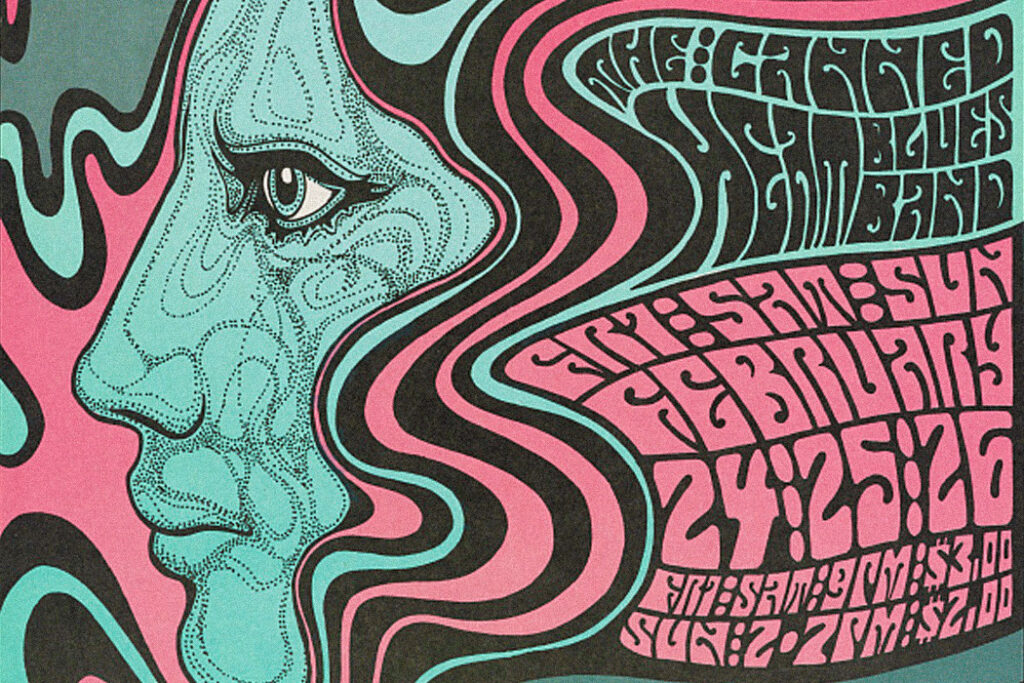
If you want to go psychedelic for your next gig, album cover or video, check out this Psychedelic Music Flyer by Muhamadiqbalhidayat or these Colorful Psychedelic and Psychedelic Dance videos by nguluidu.
“After adopting subtle retro influences in 2019, creatives have been diving head first into the psychedelic 70s this year,” says Kate. “Bold color choices, flower motifs, paisley patterns and curvy serif fonts. It’s not as kitsch-y as the original designs were, instead evoking a nostalgic, relaxed and cheerful aesthetic.”
With that in mind, certain elements of retro design may actually be repeated from former designs. They may have been altered to fit the then-modern sensibilities, or they may just have been copied completely. Either way, the odds are that your retro design will incorporate throwback design elements from multiple eras, whether you intend to or not.And this does not harm.
Cover image
Yes, the AI-generated cover photos created using Venngage’s tools are copyright-free. You can use them for both personal and commercial purposes without any restrictions on copyright. However, it’s always good practice to ensure that any externally sourced content you include is also cleared for use.
Want to showcase your love for travel, art, or a favorite hobby? Or maybe you want to project a more professional image? Our tool allows you to customize your cover photo to match your vibe. It’s quick, easy, and ensures your profile makes a lasting impression.
Discover a world of design possibilities with our extensive collection of exclusive templates. Tailor each design effortlessly to echo your unique message and watch your ideas come to life. Say goodbye to the hassle of searching for the perfect cover photo dimensions. We provide every size you need, ensuring your images always look their best without the fuss.
Theatrical artwork
The Old Woman Cooking Eggs is a more mundane example of theatricality within artwork, but one that is essential to completing the metaphor. Velazquez’s earlier work focused on depicting the more general aspects of daily peasant life, such as his Water Carrier piece, and The Old Woman Cooking Eggs is no exception to that. However, part of the charm of the piece in differing from Titian’s scene with Christ is that even without the blatant historical references and sheer magnitude of iconographical emotion it still possesses an equally compelling sense of theatrical narrative, regardless of how uninteresting the subject matter may seemingly be. The sharply contrasted figures are organic, and rendered precisely enough to be very believable within their setting. It is possible that this snapshot of daily life was almost more compelling to a casual viewer due to its basic relatability. The commission’s close ties to the working class suggest that this piece very intentionally references its subject matter in a natural, organic form, further increasing its ties to theatrical representation.
Isabella studied at the University of Cape Town in South Africa and graduated with a Bachelor of Arts majoring in English Literature & Language and Psychology. Throughout her undergraduate years, she took Art History as an additional subject and absolutely loved it. Building on from her art history knowledge that began in high school, art has always been a particular area of fascination for her. From learning about artworks previously unknown to her, or sharpening her existing understanding of specific works, the ability to continue learning within this interesting sphere excites her greatly.
Classic theatre productions include Sophocles’ Oedipus Rex, William Shakespeare’s Hamlet, and Molière’s Tartuffe. These works have set benchmarks for storytelling and are studied for their intricate plots, character development, and influence on the genre.
In contrast to short stories or novels where readers often have to wait for a character’s introduction to discern their significance, plays typically present characters prominently and early on. The character list is usually found in the initial pages of the play because, prioritizing action over narration, actors need to familiarize themselves with their roles.
Yet it is often assumed that the theatrical experience can be assimilated by reading the text of a play. In part, this is a result of the influence of theatrical critics, who, as writers, tend to have a literary orientation. Their influence is magnified by the fact that it is difficult to make serious theatre widely available; for each person who sees an important production in a theatre, thousands of others will know it only through the notices of critics. While reviewers in the mainstream press may give greater credence to such elements as acting and dancing, critics in the more serious journals may be more interested in textual and thematic values. Such influences vary from country to country, of course. In New York City a critic for one newspaper, such as The New York Times, may determine the fate and historical record of a production, assuring it a successful run or forcing it to close overnight. In London, however, audiences have notoriously resisted the will of the critics.
